

School of Engineering Graduate STEM-designated
Master’s in Artificial Intelligence
MS Master of Science in Artificial Intelligence
A STEM-designated MS for engineers and analysts moving into applied AI, with concentrations in cybersecurity, analytics, computer vision and robotics.
Start here
Is this program built for you?
Three routes into the same degree. Find yours — the honest answer is in the last line of each card.
Route 01
Your bachelor’s isn’t in computing
You studied maths, engineering, biology, economics, psychology — something analytical, but not computer science. You can read code but you have never shipped a model.
Your first semester is a structured technical onramp, not a sink-or-swim term. This is the route the program was designed around.
Route 02
You’re a working technologist pivoting
You already build software, run data, or manage infrastructure. What you want is depth in machine learning and a credential that makes the pivot legible to a hiring manager.
Go straight to the concentration that matches your target role and use electives as the specialism. Small classes mean advising can actually sequence it around you.
Route 03
You’re applying from outside the US
You need to know three things before anything else: is the degree STEM-designated, what are the real deadlines, and is the GRE going to stop you.
Yes it is STEM-designated; deadlines are 15 July and 1 December; the GRE is often waived on prior academic performance.
The real decision
Four concentrations. Pick one, or combine.
Each track changes what you build, which labs you live in, and which jobs you are a natural candidate for.
Still deciding?
Read all four and still torn? That is the normal outcome — and it is exactly the conversation an advisor is for.
Talk to an advisorCybersecurity
Apply machine learning to the defensive problem: spotting the anomaly in a stream of ordinary-looking traffic, and building systems that keep working when part of them is under attack.
What you’ll work on
- Detection models that flag anomalies in network and log data
- Adversarial thinking — how models themselves get attacked and evaded
- Resilient system design, where failure is assumed rather than avoided
- The governance side: what you can and cannot automate in a security decision
Representative course themes
- AI for security operations and resilient systems
- Machine learning systems and responsible deployment
- Data handling at scale for security telemetry
Roles graduates target
Data sciences & analytics
The concentration for turning messy organisational data into a decision. Heavier on statistics, modelling, and communication than on model architecture — and the most portable of the four across industries.
What you’ll work on
- Predictive and forecasting models on real, imperfect datasets
- Feature engineering and the unglamorous work of data quality
- Experiment design — knowing when a result is actually a result
- Communicating a model’s limits to people who will act on its output
Representative course themes
- Business intelligence and applied analytics
- Machine learning systems and responsible deployment
- Data engineering foundations for analytical work
Roles graduates target
Deep learning & computer vision
The deepest technical track. You work on the models themselves — how representations are learned, why architectures behave the way they do, and how a network moves from a research paper to something that runs.
What you’ll work on
- Neural network architectures and how representations are learned
- Image, video, and multimodal models end to end
- Training practicalities: data pipelines, compute limits, evaluation
- Reading current research and reproducing what it claims
Representative course themes
- Computer vision and representation learning
- Deep learning theory and practice
- Machine learning systems and responsible deployment
Roles graduates target
Robotics & automation
Where AI meets a physical machine and a real-world tolerance. Sensing, control, and autonomy, with lab hardware you actually put your hands on in the RISC and IET labs.
What you’ll work on
- Intelligent sensing — fusing imperfect signals into a usable picture
- Control and motion planning for autonomous behaviour
- Hands-on lab and makerspace builds, not simulation only
- Safety and failure modes when software moves mass
Representative course themes
- Robotics, control, and intelligent sensing laboratories
- Autonomous systems and automation
- Computer vision for perception
Roles graduates target
The shape of the degree
From onramp to capstone
How the credits actually sequence, whichever concentration you take.
Technical onramp
Foundations in programming, mathematics for machine learning, and data handling — scaled to the background you arrive with, so a non-computing degree is a starting point rather than a gap.
AI core
The shared spine every student takes: machine learning systems, responsible deployment, and the theory that makes the concentration courses make sense.
Concentration depth
At least three courses in each specialisation area you select — cybersecurity, analytics, deep learning and vision, or robotics. Take two areas if your target role sits on a boundary.
Applied work
Project and lab work in the RISC and IET labs and the makerspace — the part of the transcript a hiring manager asks you to talk through in an interview.
Curriculum update: the program is 34 credit hours today and moves to a 30-credit curriculum starting fall 2026, at which point ENGR 400 will no longer be required. The requirements that apply to you depend on your entry term — confirm your plan of study with Graduate Admissions.
Academic catalogWhere the work happens
Labs you get your hands on
Small graduate cohorts mean lab access is a normal part of the week, not something you compete for.
Robotics, Intelligent Sensing & Control Laboratory
Physical robotics and autonomy work — sensing, control, and the gap between a model that works in simulation and one that works on hardware.
Intelligent & Emerging Technologies Lab
Applied research across learning systems and computer vision, including the compute needed to train and evaluate models rather than only read about them.
Interdisciplinary makerspace & fabrication
Shared fabrication resources for building the thing your model runs on — and for the cross-disciplinary projects that come out of a small campus.
Where it leads
What you can do with it
AI work is no longer confined to technology companies — healthcare, finance, logistics, manufacturing, and the public sector all hire for these roles now.
A STEM-designated degree, and what that means
School of Engineering master’s degrees are STEM-designated. For eligible international graduates that opens extended post-completion practical training (STEM OPT) beyond the standard period — in practice, more time to convert the degree into US work experience.
Eligibility is an immigration determination rather than a university one, so confirm your own case with International Admissions before you plan around it.
Recognition
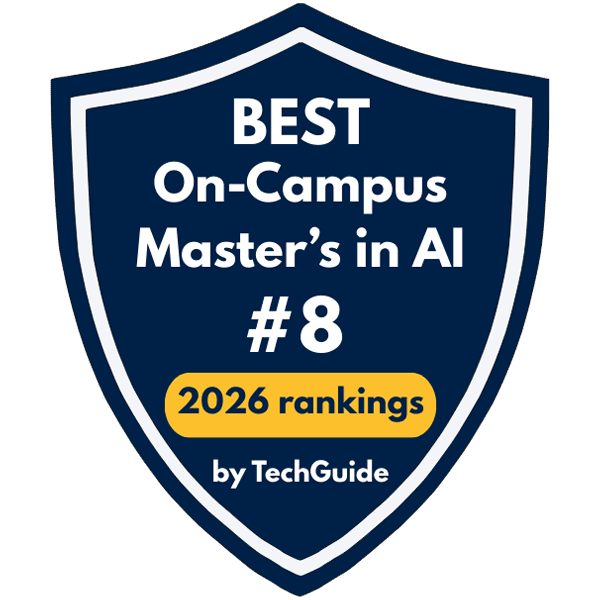
Ranked among the best on-campus master’s in AI
UB launched the first artificial intelligence master’s in Connecticut and has kept building the course stack since — taught by faculty who publish and build in the field, in classes small enough that they know your project.
Ranking reference: TechGuide, 2025–2026.
From the cohort
Graduates, in their own words
“Dedicated professors, supportive classmates, and a beautiful campus — I completed my master’s in Artificial Intelligence with a deeper love for the field and more confidence heading into industry.”
“I came in with limited programming background; faculty helped map a path that made graduate AI coursework achievable and career-ready.”
Getting in
What it takes, and by when
Everything the separate admission page used to carry, on the page you are already reading.
What you need
- A bachelor’s degree from an accredited university or recognised international institution
- A cumulative undergraduate GPA of 2.90 or higher (recommended, not an absolute cut-off)
- The online application
- Official transcripts for your last degree earned — send them from every institution you attended and you are also considered for scholarships and waivers
- GRE: often waived based on prior academic performance. Apply first; Admissions will tell you if a score is needed for your file
- International applicants: English proficiency evidence and visa documentation are handled by International Admissions — start that thread early
Deadlines & entry terms
Straight answers
Questions applicants actually ask
Do I need a computer science degree to apply?
No. The program admits students from a range of undergraduate backgrounds, and the first semester is structured as a technical onramp into graduate-level AI rather than assuming you arrive with it. What you do need is a bachelor’s degree from an accredited or recognised institution.
Is the GRE required?
Not always. The GRE can be waived based on prior academic performance. In practice you submit your application and supporting documents, and you may be admitted without a GRE score — or Admissions will contact you if one is needed for your file.
How many credits is the degree, and how long does it take?
The program is 34 credit hours today and moves to 30 credits starting fall 2026, at which point ENGR 400 is no longer required. Contact Admissions for the current plan of study, since the requirements that apply to you depend on your entry term.
Is the program STEM-designated? Can I work in the US afterwards?
Yes — School of Engineering master’s degrees are STEM-designated, so eligible international graduates may qualify for extended post-completion practical training (STEM OPT). Eligibility is an immigration determination, not a university one, so confirm your specific case with International Admissions before you rely on it.
Can I take more than one concentration?
Yes. You may select one or more specialisation areas, completing at least three courses in each area you choose. Two concentrations is a real option for students whose target roles sit at a boundary — vision plus robotics, or analytics plus security — but map it with an advisor first so the elective count works out.
Is the program offered online?
This MS is delivered on campus in Bridgeport, with access to the RISC and IET labs and the makerspace that the robotics and vision work depends on. International applicants should apply for the on-campus program path. If you need an online graduate option, filter the program finder by Online.
What does it cost?
Graduate tuition, fees, and the scholarships and assistantships that offset them are published centrally and change by year, so this page links rather than quotes. Transcripts from every institution you attended are worth submitting — they are used for scholarship and waiver consideration.
More in engineering & technology
Ready to specialise in AI?
Talk to graduate admissions about prerequisites, the credit transition, STEM designation, and which cohort start fits your timeline.